Research
Publications
Peer-reviewed research in machine learning and smart grid analytics.
2025
- Conference
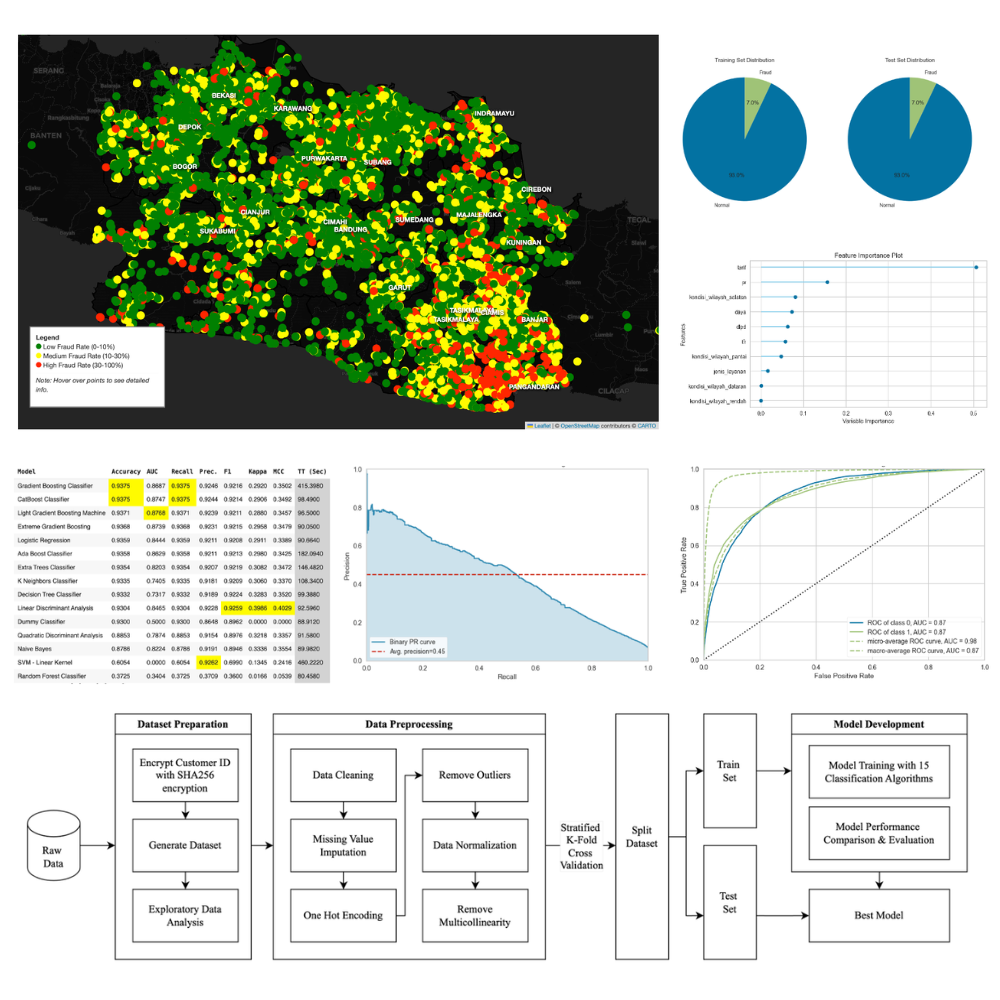 Machine Learning-based Electricity Theft Detection Considering Customer Consumption Pattern and Geographical ConditionDino Arla, and Achmad ChoiruddinIn 2025 International Conference on Data Science and Its Applications (ICoDSA), Jakarta, Indonesia, 2025
Electricity theft continues to pose significant challenges for power utilities, especially in developing countries, resulting in considerable non-technical losses and operational inefficiencies. This study presents a machine learning-based framework for electricity theft detection that integrates customer consumption pattern behavior such as tariff category, contracted power and service type with geographic context, including transformer-level fraud rates and district-level poverty indices. The model is trained and tested using real-world data from PLN, derived from on-site inspection records conducted between 2019 and 2023, encompassing over 6.7 million rows of data collected through the Electricity Usage Enforcement Program. Fifteen classifiers are compared under stratified 10-Fold Cross Validation on the 70 percent training split and hold out 30 percent of the data for final testing, avoiding synthetic oversampling to preserve genuine data distribution. The top model Gradient Boosting Classifier achieves an F1-score of 0.92 and AUC of 0.85 on a holdout dataset, detecting 93% of all inspections, both theft and non-thefts at 92% precision. Feature-importance and confusion-matrix analyses confirm that our framework excels at minimizing false positives while surfacing the most informative risk indicators for targeted inspections. By leveraging solely real inspection data and scalable preprocessing pipelines, this approach provides utilities with an intelligent, data-driven tool for proactive fraud prevention, optimized resource allocation, and significant reduction of non-technical losses.
@inproceedings{dino2025didin, doi = {10.1109/ICoDSA67155.2025.11157579}, location = {Jakarta, Indonesia}, title = {Machine Learning-based Electricity Theft Detection Considering Customer Consumption Pattern and Geographical Condition}, author = {Arla, Dino and Choiruddin, Achmad}, booktitle = {2025 International Conference on Data Science and Its Applications (ICoDSA)}, year = {2025}, organization = {IEEE} } - Conference
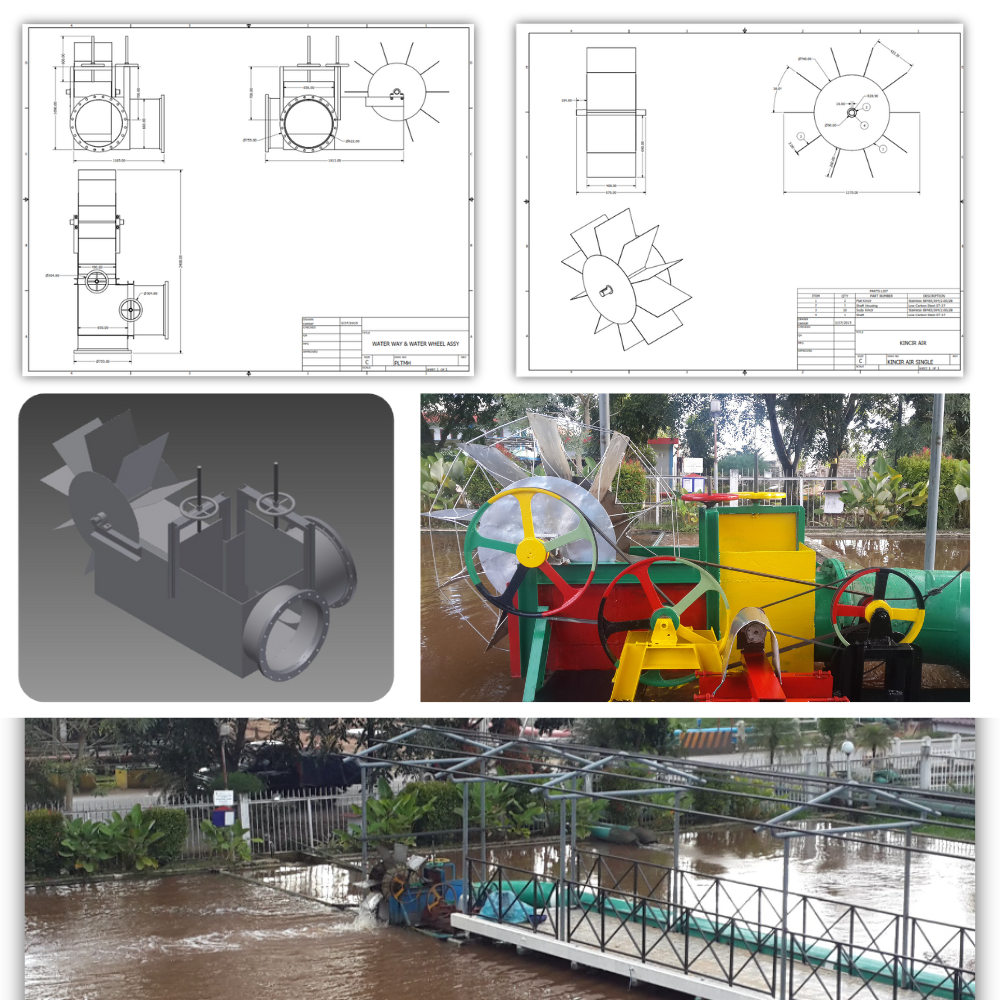 Eco En Liza (Utilization of Diesel Engine Coolant Waste Energy as a Source of Electricity for Micro Hydroelectric Power Plants)Dino Arla, Caesar Wira Sanjaya, Muhamad Hidayah Sidiq, Qashtalani Haramaini, and 1 more authorIn 2025 International Conference on Technology and Policy in Energy and Electric Power (ICT-PEP), Yogyakarta, Indonesia, 2025
Eco En Liza (Efficient Coolant Energy Utilization for Lighting in Siantan) is an innovative system designed to recover waste energy from diesel engine coolant in the Siantan Diesel Power Plants and convert it into usable electrical power through a micro-hydroelectric power plant. Unlike conventional open-loop cooling systems where coolant is discharged without energy recovery, Eco En Liza harnesses the kinetic energy of ex-coolant flow using an undershot water wheel coupled to a generator. This paper presents the system design, mathematical modeling, and experimental validation of the proposed solution. The results demonstrate that the recovered energy is sufficient to supply the facility’s lighting load, reducing dependency on auxiliary kWh machines and achieving operational cost savings. The novelty of this work lies in the application of hydromechanical conversion for coolant waste recovery in diesel power plants, contributing to broader renewable energy initiatives and aligning with sustainable development goals.
@inproceedings{dino2025eco,
  doi = {10.1109/ICT-PEP67281.2025.11232224},
  location = {Yogyakarta, Indonesia},
  title = {Eco En Liza (Utilization of Diesel Engine Coolant Waste Energy as a Source of Electricity for Micro Hydroelectric Power Plants)},
  author = {Arla, Dino and Wira Sanjaya, Caesar and Sidiq, Muhamad Hidayah and Haramaini, Qashtalani and Fadliqaf, Sutan Hafif},
  booktitle = {2025 International Conference on Technology and Policy in Energy and Electric Power (ICT-PEP)},
  year = {2025},
  organization = {IEEE}
}


2024
- Journal
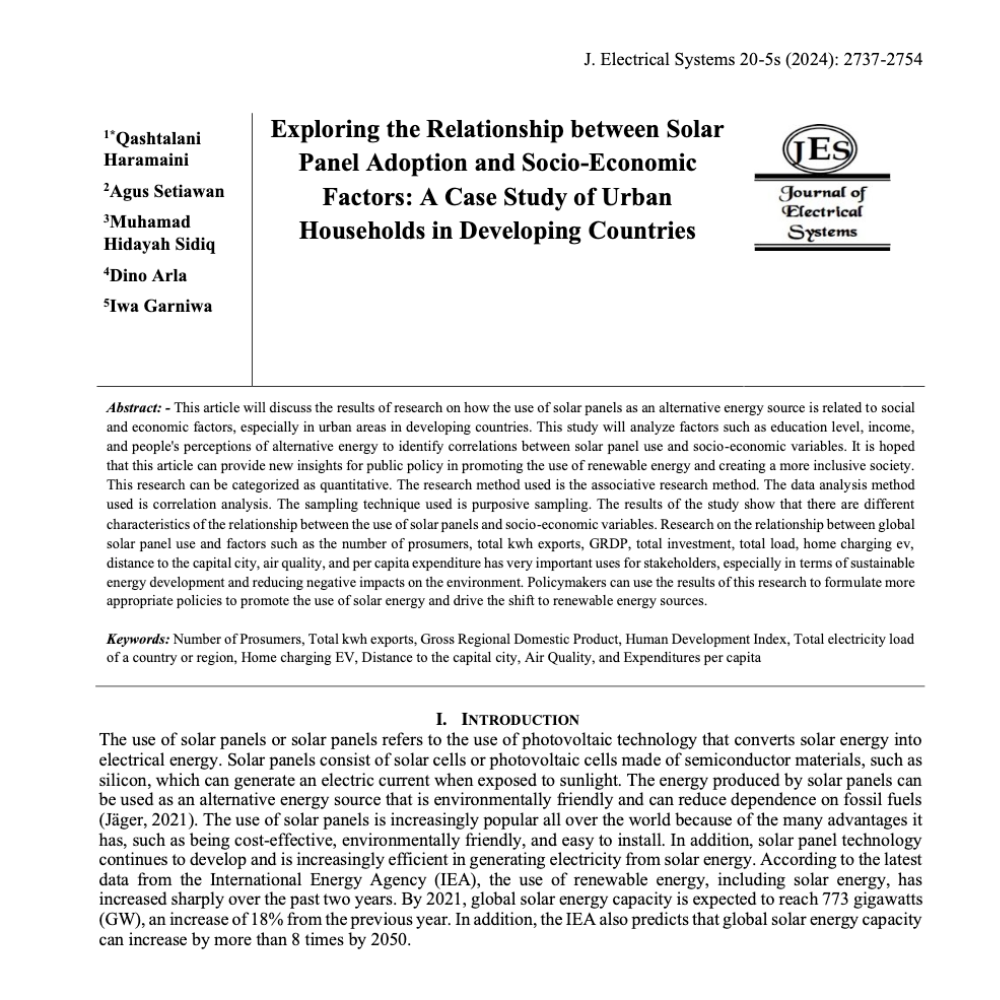 Exploring the Relationship between Solar Panel Adoption and Socio-Economic Factors: A Case Study of Urban Households in Developing CountriesQashtalani Haramaini, Agus Setiawan, Muhamad Hidayah Sidiq, Dino Arla, and 1 more authorJournal of Electrical Systems, 2024
This article will discuss the results of research on how the use of solar panels as an alternative energy source is related to social and economic factors, especially in urban areas in developing countries. This study will analyze factors such as education level, income, and people’s perceptions of alternative energy to identify correlations between solar panel use and socio-economic variables. It is hoped that this article can provide new insights for public policy in promoting the use of renewable energy and creating a more inclusive society. This research can be categorized as quantitative. The research method used is the associative research method. The data analysis method used is correlation analysis. The sampling technique used is purposive sampling. The results of the study show that there are different characteristics of the relationship between the use of solar panels and socio-economic variables. Research on the relationship between global solar panel use and factors such as the number of prosumers, total kwh exports, GRDP, total investment, total load, home charging ev, distance to the capital city, air quality, and per capita expenditure has very important uses for stakeholders, especially in terms of sustainable energy development and reducing negative impacts on the environment. Policymakers can use the results of this research to formulate more appropriate policies to promote the use of solar energy and drive the shift to renewable energy sources.
@article{haramaini2023solar, title = {Exploring the Relationship between Solar Panel Adoption and Socio-Economic Factors: A Case Study of Urban Households in Developing Countries}, author = {Haramaini, Qashtalani and Setiawan, Agus and Sidiq, Muhamad Hidayah and Arla, Dino and Garniwa, Iwa}, journal = {Journal of Electrical Systems}, volume = {20}, number = {5s}, pages = {2737--2754}, year = {2024} } - Conference
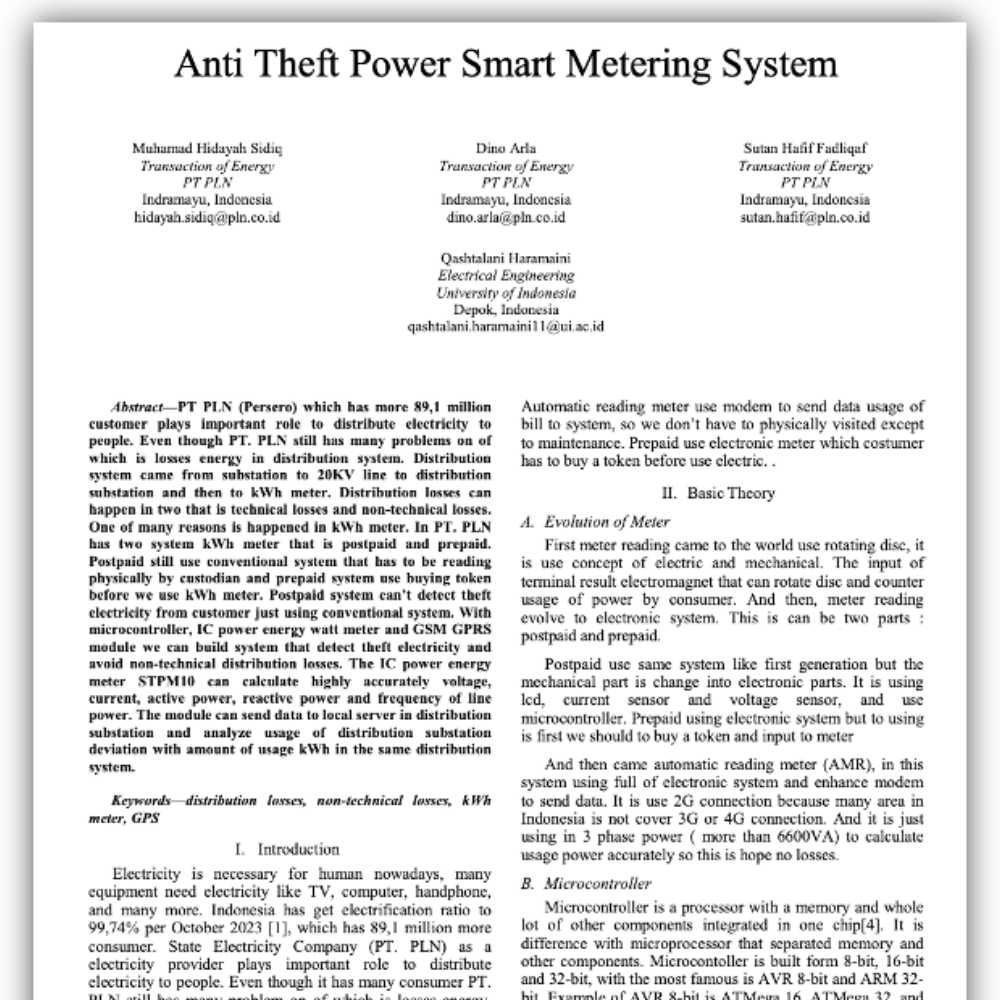 Anti Theft Power Smart Metering SystemMuhamad Hidayah Sidiq, Dino Arla, Sutan Hafif Fadliqaf, and Qashtalani HaramainiIn 2024 International Conference on Technology and Policy in Energy and Electric Power (ICTPEP), Bali, Indonesia, 2024
PT PLN (Persero) which has more 89,1 million customer plays important role to distribute electricity to people. Even though PT PLN still has many problems on of which is losses energy in distribution system. Distribution system came from substation to 20KV line to distribution substation and then to kWh meter. Distribution losses can happen in two that is technical losses and non-technical losses. One of many reasons is happened in kWh meter. In PT PLN has two system kWh meter that is postpaid and prepaid. Postpaid still use conventional system that has to be reading physically by custodian and prepaid system use buying token before we use kWh meter. Postpaid system can’t detect theft electricity from customer just using conventional system. With microcontroller, IC power energy watt meter and GSM GPRS module we can build system that detect theft electricity and avoid non-technical distribution losses. The IC power energy meter STPM10 can calculate highly accurately voltage, current, active power, reactive power and frequency of line power. The module can send data to local server in distribution substation and analyze usage of distribution substation deviation with amount of usage kWh in the same distribution system.
@inproceedings{sidiq2024anti,
  doi = {10.1109/ICT-PEP63827.2024.10732892},
  location = {Bali, Indonesia},
  title = {Anti Theft Power Smart Metering System},
  author = {Sidiq, Muhamad Hidayah and Arla, Dino and Fadliqaf, Sutan Hafif and Haramaini, Qashtalani},
  booktitle = {2024 International Conference on Technology and Policy in Energy and Electric Power (ICTPEP)},
  pages = {287--290},
  year = {2024},
  organization = {IEEE}
}


2023
- Book
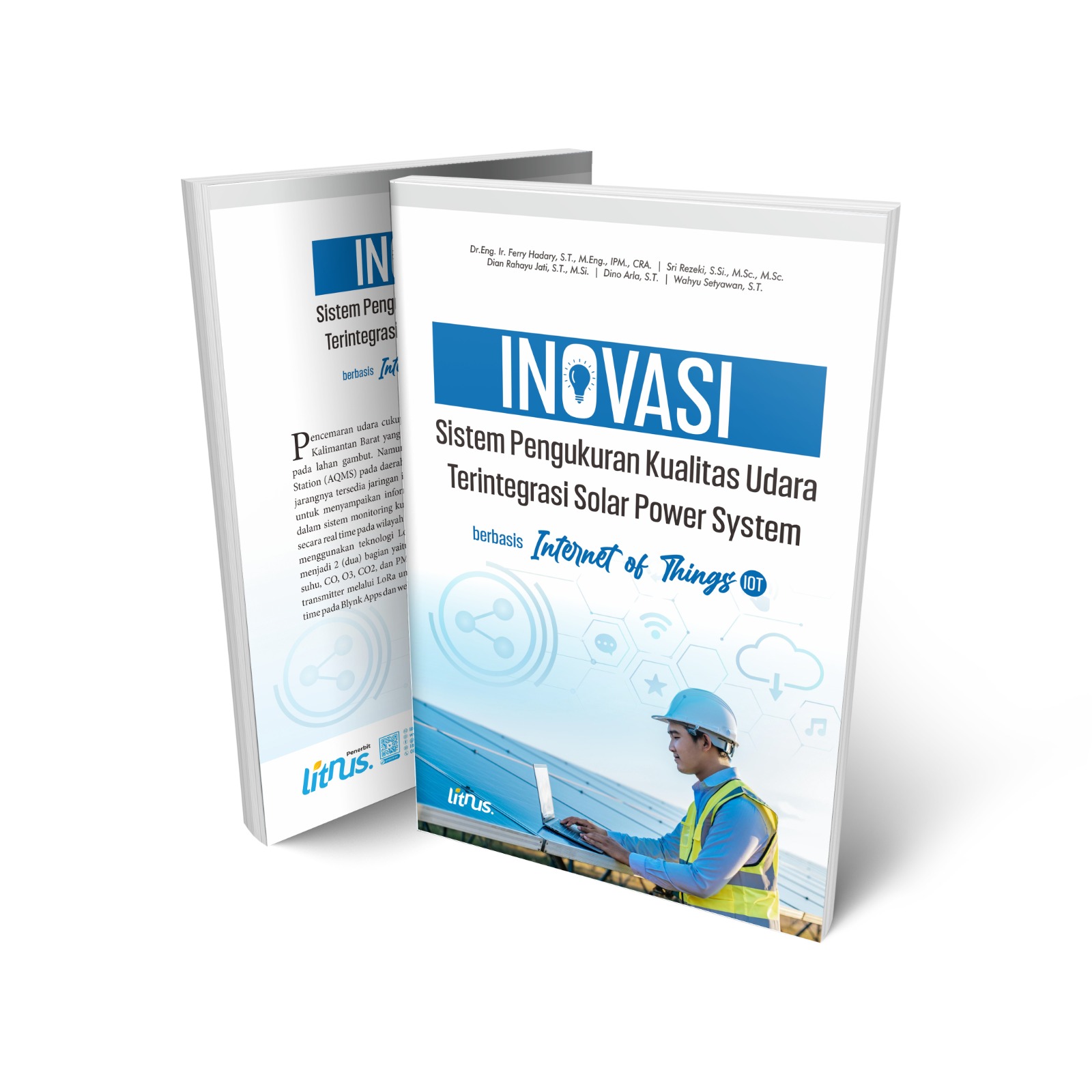 Inovasi Sistem Pengukuran Kualitas Udara Terintegrasi Solar Power System Berbasis Internet of Things (IoT)Ferry Hadary, Sri Rezeki, Dian Jati, Dino Arla, and 1 more author2023
Permasalahan kualitas udara kerap kali menjadi masalah yang sering terjadi baik di kota-kota besar dan juga pinggiran. Polutan yang berasal dari kendaraan bermotor dan industri yang kemudian dibuang ke lingkungan, pembukaan lahan dengan cara membakar hutan atau belukar akhirnya menjadi perangkap radiasi matahari sehingga mengakibatkan suhu meningkat dan efek iklim mikro menguat. Permasalahan terkait lingkungan dan manusia ini kemudian memerlukan tindakan mitigasi untuk memperkuat sistem informasi kebencanaan khususnya mengenai kualitas udara. Buku ini memaparkan inovasi dari hasil penelitian untuk mengatasi permasalahan tersebut yaitu berupa alat untuk mengukur kualitas udara secara portable berbasis Internet of Things (IoT). Inovasi yang dilakukan adalah alat dapat menampilkan data real time melalui koneksi internet dengan memanfaatkan website dan smartphone android sebagai Graphical User Interface (GUI). Selain itu untuk wilayah pinggiran/rural dipaparkan pula inovasi berupa penggunaan teknologi Long Range (LoRa).
@misc{hadary2023inovasi, title = {Inovasi Sistem Pengukuran Kualitas Udara Terintegrasi Solar Power System Berbasis Internet of Things (IoT)}, author = {Hadary, Ferry and Rezeki, Sri and Jati, Dian and Arla, Dino and Setyawan, Wahyu}, year = {2023} } - Patent
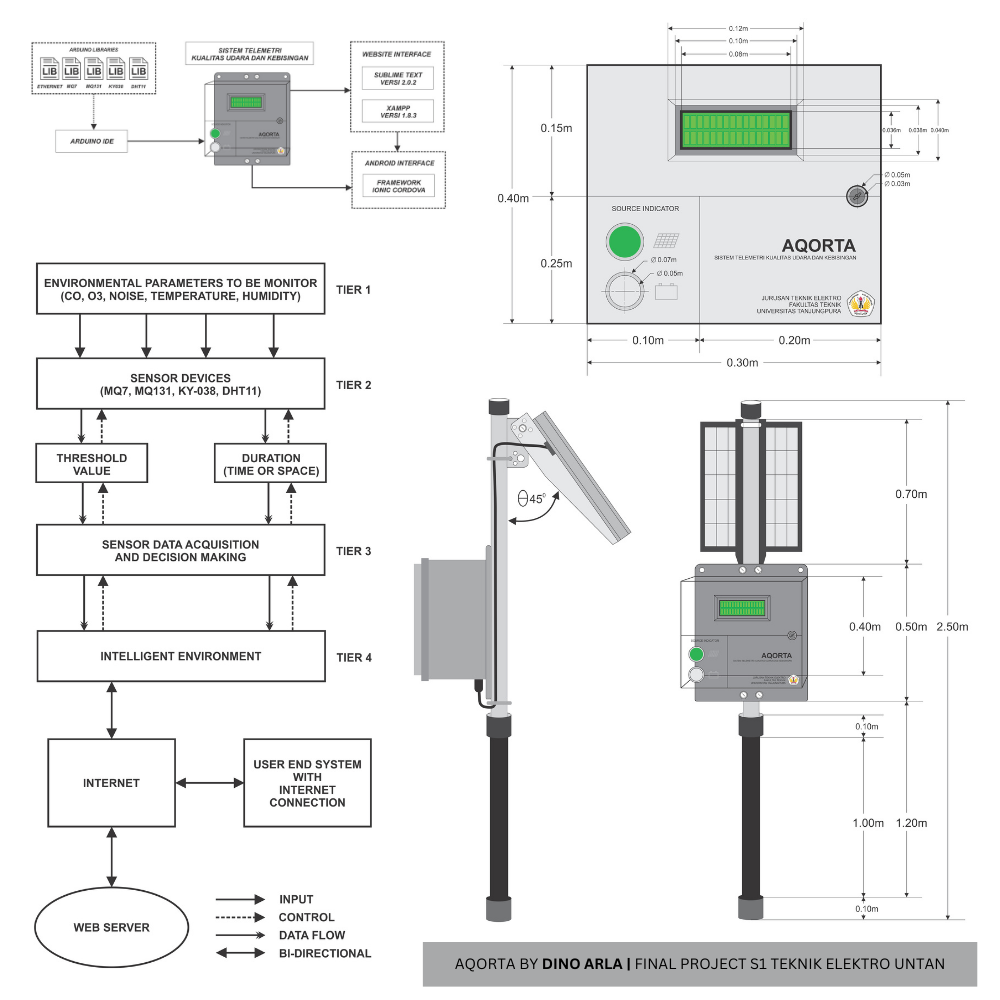 AQORTA (Air Quality and Noise Real Time Data Acquisition) Sistem Telemetri Kualitas Udara dan Kebisingan Terintegrasi Solar Power SystemFerry Hadary, Dino Arla, Sri Rezeki, Dian Jati, and 1 more authorJul 2023ID Patent: P00202112421
Invensi sistem AQORTA ini berkaitan dengan implementasi sistem telemetri kualitas udara dan kebisingan yang dapat merekam data pengukuran ke dalam database MySQL, serta menampilkan data hasil pengukuran melalui Graphical User Interface (GUI) secara waktu nyata. Sistem ini terdiri dari dua bagian, yaitu bagian perangkat keras (hardware) dan perangkat lunak (software). Bagian hardware diletakkan di lokasi pengukuran dan berfungsi untuk merekam data kualitas udara (CO, O3, temparatur, kelembaban) dan kebisingan serta mengirimkan data ke database MySQL yang ter-install pada web server. Bagian perangkat lunak diakses melalui GUI berbasis halaman website dan aplikasi pada smartphone android guna memvisualisasikan data hasil pengukuran dalam bentuk indikator gauge, grafik, tabel, dan geolocation data berbasis google maps Application Programming Interface (API). Catu daya utama pada AQORTA ini menggunakan panel surya dan accu dengan tegangan 12 volt DC yang dikendalikan oleh solar charge controller. Konsumsi energi listrik perangkat keras adalah 78,49 Wh selama 1 hari.
@misc{hadary2023aqorta, title = {AQORTA (Air Quality and Noise Real Time Data Acquisition) Sistem Telemetri Kualitas Udara dan Kebisingan Terintegrasi Solar Power System}, author = {Hadary, Ferry and Arla, Dino and Rezeki, Sri and Jati, Dian and Rustamaji, R.M}, year = {2023}, month = jul, note = {ID Patent: P00202112421} } - Journal
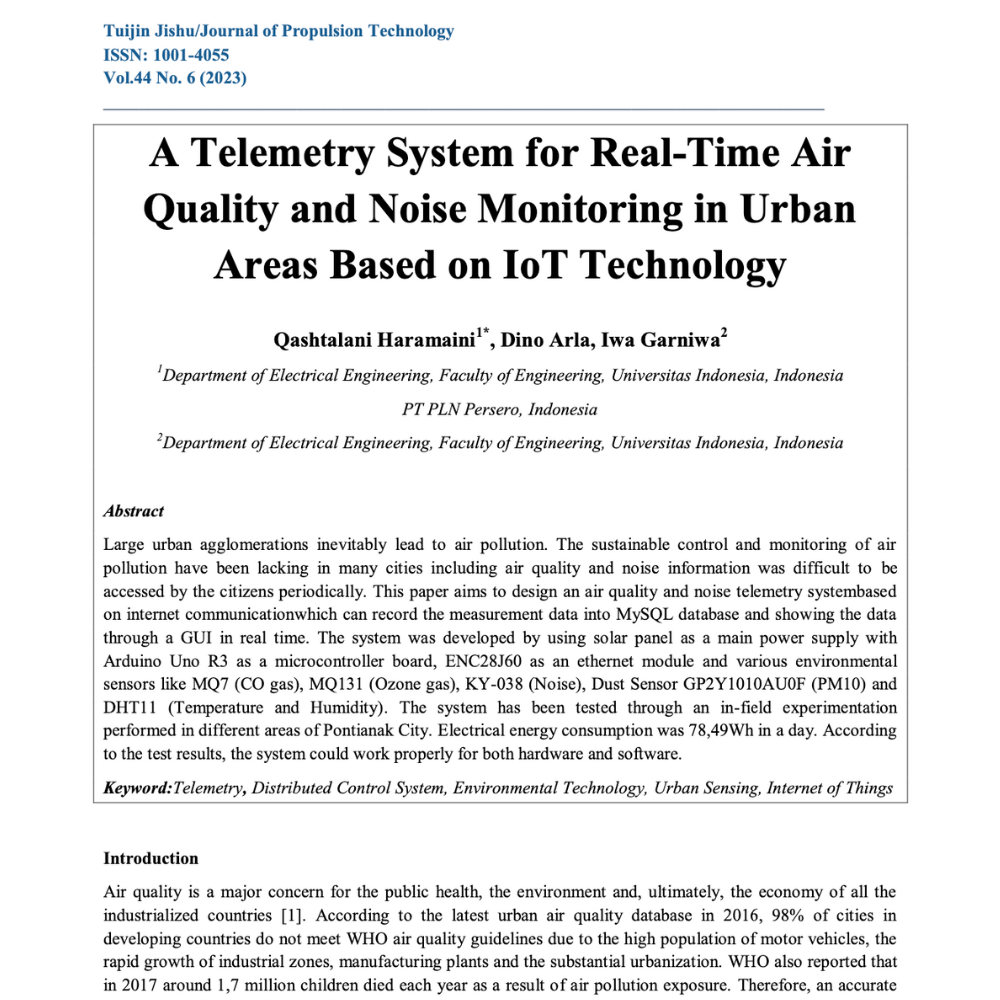 A Telemetry System for Real-Time Air Quality and Noise Monitoring in Urban Areas Based on IoT TechnologyQashtalani Haramaini, Dino Arla, and Iwa GarniwaTuijin Jishu/Journal of Propulsion Technology, Jul 2023
Large urban agglomerations inevitably lead to air pollution. The sustainable control and monitoring of air pollution have been lacking in many cities including air quality and noise information was difficult to be accessed by the citizens periodically. This paper aims to design an air quality and noise telemetry systembased on internet communicationwhich can record the measurement data into MySQL database and showing the data through a GUI in real time. The system was developed by using solar panel as a main power supply with Arduino Uno R3 as a microcontroller board, ENC28J60 as an ethernet module and various environmental sensors like MQ7 (CO gas), MQ131 (Ozone gas), KY-038 (Noise), Dust Sensor GP2Y1010AU0F (PM10) and DHT11 (Temperature and Humidity). The system has been tested through an in-field experimentation performed in different areas of Pontianak City. Electrical energy consumption was 78,49Wh in a day. According to the test results, the system could work properly for both hardware and software.
@article{haramaini2023telemetry,
  title = {A Telemetry System for Real-Time Air Quality and Noise Monitoring in Urban Areas Based on IoT Technology},
  author = {Haramaini, Qashtalani and Arla, Dino and Garniwa, Iwa},
  journal = {Tuijin Jishu/Journal of Propulsion Technology},
  volume = {44},
  number = {6},
  pages = {446--455},
  year = {2023}
}


